First Light, Haleakala
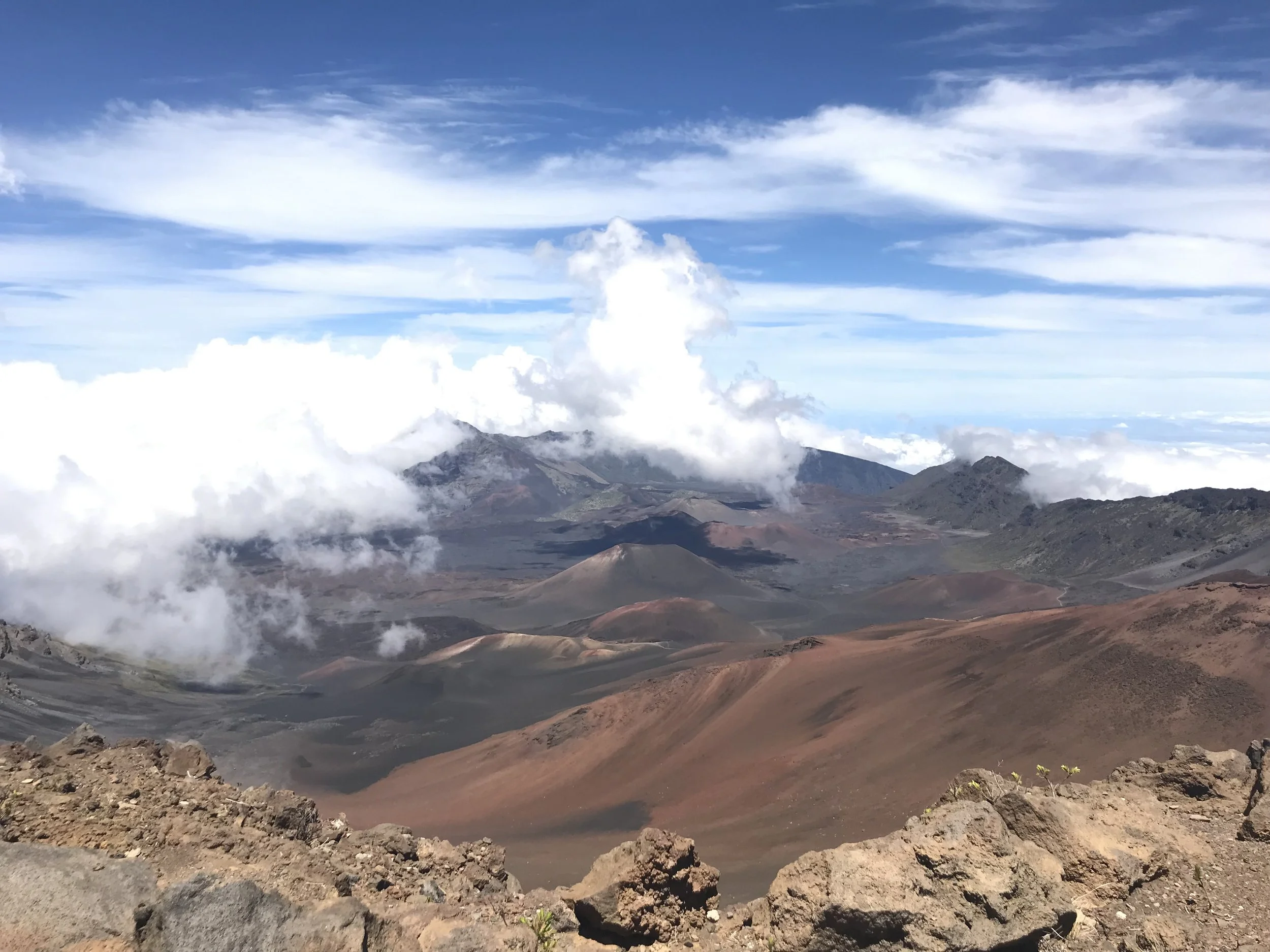
Perched on the side of an impossible mountain in the middle of the Pacific Ocean is a primitive campground with six small campsites.
It’s really more of a meadow than a campground, except you are allowed to sleep here if you plan ahead. A reservation, booked six months in advance, costs less than a coffee—a wild privilege for such a small price.
It’s well past midnight, and everyone else is sleeping. The temperature hovers somewhere near perfect: 55 degrees with a warm wind coming down the mountain.
I am standing outside the toilets watching the Milky Way spin across the sky. A billion stars. A cosmic cloud that contains everything I can think of. Beauty and mystery and meaning. I want to lie down and feel the Earth beneath me, feel myself hurdling through time and space, know that I am part of it all. But right now, I have urgent matters to deal with.
From the waist down, I am covered in vomit—my own though, thank goodness. I can smell the butyric stench of stomach acid and tomatoes. There are chunks of cottage cheese in the Velcro of my sandals. I missed the hole in the pit toilet and hit the rim instead. It all came bouncing back at me.
Also, in the urgency of the moment, in my haste not to throw up where anyone might notice, I bent over with my headlamp on, its soft red light illuminating the depths of the latrine and 20 years of what people have put there. You’re really never supposed to look inside. Especially not with a flashlight.
We are here—my husband, my nine-year-old son, and I—because we’re going to hike the 20-mile triangular route inside the top of this mountain. Nine miles tomorrow. Set up camp on the far side of the caldera. Seven miles the next day. Sleep on the edge of the world. Then four miles up the switchbacks to where our rental car will be waiting.
This is Haleakala. Maui. Where the sun lives.
Last summer, toward the end of the pandemic, we spent a month in Hawaii—three weeks on the Big Island and one week here in Maui—but only a few hours on this mountain. I didn’t expect it to grab me this way. I didn’t reserve enough time to explore it. But peering over the edge that first time felt like being punched in the heart, and I started to crave a moment alone here. I’ve been planning this hike ever since.
Today
Haleakala is painfully beautiful. It’s like stepping into another world. The temperature drops 30 degrees as you drive to the top. The telescopes and observatories at the summit feel like, suddenly, you’re in Star Wars. Then you come to the edge of the caldera, the top of the volcano worn down into a bowl of soft, sandy mounds in red, black, brown, and gray, and the heat returns, with the wind beside it. It’s almost impossible not to fall in love. The cinder cones call like Sirens. “Come inside and look around.”
Last time we were here, we hiked down a mile or two but didn’t have the gear, or the time, to go farther. It didn’t feel safe. I told myself, this is how so many hundreds of people end up hurt or just dehydrated and exhausted every year in the Grand Canyon. It begs you to come explore. Go deeper. Peek around the next corner. Forget about the climb back out.
This time, we have plenty of food and water, an extensive first aid kit, and our backcountry camping gear. I am stoked to see the far Eastern side. To hear the mountain at night. To learn what it smells like in the very center.
Haleakala is supposed to be the quietest place on Earth. No cities nearby for hundreds of miles; no plane traffic overhead; and the sand absorbs the sounds that do get in, like a padded room or a float tank. I crave that silence, that sense of solitude and isolation. I want to believe, just for a moment, that we are the only three people alive.
Probably, I have food poisoning. I started feeling nauseous right after dinner. Josh, my husband, made tacos on the camp stove. We had chips and salsa. And I finished the last few tablespoons of that fucking cottage cheese, just to get rid of it. But we all ate the same things, and no one else is sick.
The campground doesn’t have a dish sink, but it does have a hand-pump water spigot. I creep over, remove my sandals, socks, and pants, and start to rinse them out. God I hope no one wakes up and finds me in my underwear and puffy jacket, rinsing my pants.
I have thrown up seven times now. I can tell the job is done.
I walk barefoot in my underwear across the parking lot, through the loud, dry grasses to our tent. I hang my wet clothes on the picnic table to dry, find new socks, brush my teeth, and slink into my sleeping bag, shivering, empty, and exhausted.
My eyes burn. I only packed one pair of pants.
The good news is, our tent is mesh from the floor upward, so there’s nothing to block my view of the sky. As my eyes adjust, the Milky Way unfolds itself again. A satellite moves steadily, left to right. Suddenly, a shooting star. A few minutes later, another and another. Gratitude cascades throughout my body. I am flooded with awe and purpose and joy. It’s magical. And it’s all mine. There seem to be as many shooting stars as fixed ones.
It occurs to me that, if I weren’t sick, I would have missed this.
Then my stomach clenches. My bowels turn over. I hold my breath and close my eyes. I’m still shaking, and my tongue is swollen. I really wish I’d brought more pants.
My mind whipsaws. Maybe I’m not supposed to be here. Maybe Pele—the goddess who created Hawaii, the earth-eating woman who rules all fire and wind and destroys the things that need to be destroyed—maybe she is pissed and wants me to leave. A big part of me loves this idea. If Pele is punishing me, it means I’m special.
The next morning, I tell Josh and our son, Killian, the gory details. Josh says we should skip the hike. But I’m fine. Let’s not make a big deal of it.
He cooks a big, hot breakfast for Killian while I sip water and try to escape the smells of their food. My pants are dry and spotless now, but I think I will burn them when we get home.
The boys want to hike a little nature trail behind the campground before we go into the caldera. They tromp into the eucalypts. I sit alone in the parking lot, a few feet behind our car, and try to eat a section of an orange. From the outside, I know it’s weird to plant myself in the middle of the asphalt, but I have no will to move.
They’re gone for maybe half an hour. In that time, the campground empties as everyone heads up or down the mountain for the day. In no time, it refills. Two park rangers arrive, plus a few small groups of tourists. They swerve their cars around me to reach the parking spaces and try hard not to make eye contact. It seems the rangers are hosting a guided hike that starts nearby. They call out and ask if I might like to join, but I just raise my hand like I’m high-fiving the air. One comes over to see if everything’s OK. I smile and nod, but can’t make my voice work. They must think I’m an idiot. Or on drugs.
My boys return, and we negotiate two very different visions of the day. Eventually, I accept defeat, or tolerate it, for their sake. We spend the rest of the day and night at a hotel in Kahului. On the drive to town, I throw up the orange.
Before
The first time we came here, we camped in Olowalu.
Maui is shaped like an infinity symbol, except the left loop (East Maui) is much smaller than the right one (West Maui). Haleakala fills most of the right side, but both sides are mountainous. In the middle is a valley—essentially, a wind tunnel—that runs north to south. From the airport, it’s just a half-hour drive to Olowalu. You cut through the connective middle part, then flow east along the southern coast.
Except the day we arrived, tremendous, unbelievable winds were pillaging the island. Mokulele Airlines dropped us off in a nine-person Cessna from the Big Island, and told us before they opened the door that we should hold on to our hats and small children. The pilots didn’t seem to think the weather was unusual, but it nearly knocked me down the stairs.
In Maui, the wind is almost constant, almost everywhere all the time. First, you meet the trade winds, which gather speed for thousands of miles before crashing into the north side of the island. They funnel through the valley at 40 miles per hour, day and night. Then, there are the Kona winds, which blow from the opposite direction, carrying the sulphurous smells of Kilauea volcano on the Big Island.
We couldn’t get to Olowalu the usual way, because the wind had knocked down multiple electric poles, and state officials closed the highway while repairing the lines. We had to go the long way instead, on a one-lane, two-way road, for locals only. The asphalt there hugs close to the cliffs, which fall hundreds of feet directly to the ocean.
We sat locked in a long parade of traffic. A local man in a Kingdom of Hawaii tank top with a broad smile and an old, beat-up Tacoma took charge, thank goodness, and got all us haoles to the other side safely. At his signal, we plowed forward at terrifying speeds, drove backwards to make space for ongoing traffic, or snuck past each other with less than three inches’ space between the doors of our cars. We waved the shaka at kids in their swim trunks along the road. It took nearly three hours—all of them a blast.
Our campsite was paradise until the sun set, then the wind picked up and didn’t stop. It was ferocious. Animalistic. Relentless. Like someone trying to tear their way in.
It blew the sides of the tent down onto our faces, smothering us in nylon and fine, black dirt. We attached the rain cover to keep the sand out, but it didn’t work. The dirt slipped under and inside the netting. Soot filled every crevice of everything we owned. The wind tore the rain cover but, amazingly, did not snap the tent poles.
We stayed up all night, three nights in a row, angrily wondering aloud to each other why the campground owners wouldn’t just plant some grass. My sleeping pad popped, and I had to replace it with a lime-green vinyl pool float. But frustrating circumstances are easier to cope with when you’re waking up in Hawaii.
Again to the Mountain
After a night of rest in Kahului, I wake up anxious and ravenous, eager to get moving. I get this way when I’m excited. A blurred line between happy and bitchy. But everything is back on track. My stomach has settled.
The plan is, we’ll hike the caldera on an abbreviated route (11 miles, not 20), and we’ll still get to spend one night inside. Josh and Killian are wild and goofy, full of vacation adventure energy.
By 10 am, Killian and I are waiting with our packs at the top of the mountain where the Sliding Sands trail begins. (Do other moms force their kids to hike overnight in volcanoes so they won’t fade away?) Josh dropped us off, parked our car down the mountain, where the hike will end, and is hitchhiking up to us. He arrives in the back of an expensive white campervan overflowing with young and boisterous French women. He tumbles out, laughing and glowing.
For the next 36 hours, we hike. One unit, moving through eternity together.
I remember mostly snapshots, not stories. The sand keeps getting in our boots. At one point, we turn left and traipse along the rims of what feel like huge ant-lion pits. Killian is nervous that Josh and I will fall in. We take breaks wherever we can find shade. We see a family of Chukar partridges. We stop to marvel at the spiky, silver plants at various points in their long, dry lives. We eat a lot of honey and almond butter sandwiches.
Haleakala is—ever so technically—an active volcano. Although it has been dormant for nearly 200 years, it will likely erupt again, one day.
But also, this is a fragile landscape, so we must be respectful. A handful of plant and animal species exist only here, including, most famously, the Haleakala silversword, which blooms just once in its 20–50-year life by sending up a huge (sometimes 9-foot-long!) stalk, covered in hundreds of big, droopy, pink flowers, then lets itself die. Each one fills me with wonder, and grief.
The mountain is roughly 10,000 feet tall, but really, it’s 30,000 feet, starting from the seafloor. For Kānaka Maoli, Haleakala is sacred. A living ancestor. A point of real, physical connection between the divine and earthly worlds. This is where the demigod Maui—mischievous, marvelous, magical Maui—lassoed the sun, and slowed its pace to create days and nights. It feels completely removed from the rest of the island. Protected and untouchable. Kapu, as it should be.
While we walk, Killian and I take turns throwing temper tantrums. We are hot and uncomfortable. We like to complain aloud. Josh, a long-time summer-camp counselor, mediates, and keeps us focused.
Late in the day, Killian lags behind. We stop to wait for him at intervals, and my chest cracks open when he crests the nearest rise.
He’s trekking alone in a pale blue shirt the same color as the sky: a tiny, determined, vulnerable child against the vast, timeless, dangerous red-black earth, in boots that are a little too big, with his long blonde hair stuck to his face. He’s sucking on one of the straps from his backpack. A total bad-ass. And god, he’s so beautiful.
We finish the day and set up camp at Hōlua, where the ground is surprisingly green. Invasive grasses, like Guinea, Buffel, and Molasses grass, cover almost a quarter of this island. Mostly, these are drought-tolerant species, introduced by haole colonists to feed ranch animals or control erosion. But they outcompete endemic grasses and dry out fast, turning the landscape into a tinderbox. Along the inside edges of the crater, where we’re camping, there are native grasses instead. I expected more black and gray, but the camping area is loamy and green.
We are tired, filthy, and sunburnt. My favorite way to be.
After the sun sets, there’s a rush of strong wind that lasts a few minutes, then stops abruptly as night takes over. The rest of the evening is eerily quiet—so quiet we can hear a group of nene birds snoring in the distance. Their voices flutter in and out, in and out, just a few feet away. I take a voice memo on my phone so I can hear them again later, then set my alarm so I won’t sleep through sunrise.
The night turns cold and surprisingly dark.
I wake up a few hours later, without my alarm, just as the sky starts to lighten. I unzip the tent and move outside with my sleeping bag to sit in the brush to watch the day begin.
When I was little, I learned my first name, Roxanne,means sunrise, or first light, in Persian. And my middle name is Dawn. Two words for the same moment. Ever since, I’ve felt a deep and intimate connection to the sun.
As it rises, I can hear both my heartbeat and my breath. Their synchronous rhythms, their endless cycles of contraction and expansion, just like the nenes’ purr. Yogis call this spanda: the divine rhythm of life. It’s a bridge between energy and consciousness. Each animal and ecosystem has its own distinct spanda, and each one is connected to the pulse of the universe.
At 5 am, in the quietest place on Earth, at the top of a mountain whose name means “House of the Sun,” I am first light, watching first light, with the divine rhythm of the universe in my ears. I am full. I am radiant, and complete.
After
A year later, I am turning 40. To celebrate, I fly to Kauai and run an ultramarathon: The Kauai 50 Miler. I set this goal so I could prove to myself that life isn’t just decay and decline from here on out. I’m determined to prove I can do new, scary, wild things—alone—forever.
I’m on my own for five days snorkeling, surfing, hiking, watching the sun rise over the ocean, and, eventually, suffering, just as I planned.
The race is 52 miles long. At mile 41, I’m in so much pain that I’m sure there’s a rock in the tip of my shoe. I sit down at an aid station and pull off my sock. Thick, dark, dirty blood covers my foot, the big toe nail white and milky, like a cataract. It has detached itself on three of four sides.
I try not to panic. Try not to cry.
The aid station has medical tape. I fake a smile and a runner’s high so the paramedic won’t suspect I’m injured.
I don’t want an audience, or help.
I strap the nail down tight and change my socks, but skip the shoes. To reach the finish line, I run-walk the next nine miles in just my socks—on horrible, ankle-rolling clumps of grass; on gravel; on hard, red clay; and along the roots of the trees.
I flow back and forth between self-pity and anger. At one point, I call Josh and ask if he thinks I should quit. I want permission to quit. I tell him: There’s a nice guy (probably a race organizer) in a pickup truck, who has already passed me once and stopped to ask if I would like a ride. Maybe I should just say yes.
But Josh reminds me I’ve run 900 miles to train for this moment. He reminds me how disappointed I’ll be if I choose the easy way out. I’ve run dozens of long races like this. I never quit, he says. But I am desperate to quit.
I text my mom, who gives me what I thought I wanted: comfort and an exit door. 41 miles is a huge achievement, she says. You have nothing to prove to anyone. You want to be able to run again one day. Do what you need to do, and celebrate what you’ve done so far.
My legs are covered in millions of tiny heat blisters and caked red dirt. A mole on my right thigh is quietly weeping blood, which rolls down my leg all the way to my knee.
I sit on the edge of the trail and cry. Despair takes over. But I finish the damn race, barefoot and steadfast.
On the flight home, my plane glides over Oahu. Diamond Head. Then Maui. It’s the start of a red-eye flight to the mainland. The pilot comes on the intercom to tell us we’re currently passing Honolulu, then Lahaina. We can see the lights of each one, glowing red and constant against the endless, deep black of the ocean. She says turbulence is normal because of the wind here, and she’ll wake us up near Phoenix.
The next day, Lahaina burns to the ground. I watch the news reports online and the videos, with my hand to my mouth. Tremendous winds; power lines go down; grasses ignite.
The whole town is gone in just a few hours. The history museum under the banyan tree, and all the artifacts inside it. My son’s favorite pirate-themed restaurant, and the Dole Whip stand. The street chickens. The stray cats. The homeless folks who camp behind the bushes. And more than 100 parents, grandparents, friends, aunts, uncles, and children. All gone in just a few hours.
Watching the footage, I recognize the culprit. It's the wind from Olowalu. The same one that closed the road and tried to break into our tent. But this time, it didn't just knock things down. It erased a whole city, and its people.
Hindsight
The wind that razed Lahaina should have been predictable. It was part of a system that had been building for decades, invisible to most people, and overlooked by those who should have paid real attention, because they could have stopped it had they known.
The wind patterns on Maui create natural fire corridors. The trade winds barrel in from the northeast, funneling through the central valley. When high-pressure systems stall over the North Pacific, they reverse into downslope Kona winds that race along the mountainsides, gathering speed and heat.
On August 8, 2023, the day Lahaina evaporated, Hurricane Dora passed far to the south of the Hawaiian islands, generating even more winds, which hit 70 miles per hour where it mattered. Maui’s grasses did the rest.
Unlike native Hawaiian grasses, which grow slowly and stay green even in dry seasons, non-native species grow quickly, die quickly, then cure into tinder when the rains stop. This creates a continuous fuel bed.
In the weeks before the fire, Maui was facing a drought. When the wind knocked the power lines down—first in the early morning, then again that afternoon after crews thought they'd solved things—the sparks found fuel everywhere. The fire moved shockingly fast through buildings and neighborhoods that had no warning. No time to get out.
But the warning signs had been there. A 2014 report that identified West Maui as high-risk for wildfire. A 2020 Maui County hazard mitigation plan that said power lines in high winds were a key ignition source, and invasive grasses could accelerate fire spread. Yet nothing changed.
The power company didn't bury the lines. The county didn't clear the grasses. Developers kept building. And climate change made it worse.
Over the past decade, Maui's average temperatures have steadily risen, and rainfall patterns have shifted, creating longer dry periods. The conditions that once made catastrophic fires rare in Hawaii (the moisture, native vegetation, and lack of lightning) have slowly disappeared. Now, wind, grass, and heat converge, and places burn that could have lasted forever.
I think about Killian hiking behind me in his pale blue shirt, nine years old and moving through the red-black silence of Haleakala like he belonged there. A haole child in a sacred, native space, awed and thankful, or just daydreaming. The landscape felt eternal.
But the wind reaches everywhere eventually. Even the silverswords are vulnerable now as climate change pushes them up the mountain, into smaller and smaller refuges. One day they will have nowhere left to go.
Will my sweet son bring his own sweet children to see the House of the Sun? If he does, will it still be silent there? Will it be green and calm and safe? Will the invasive grasses have found their way in? Will they see a silversword in bloom, or a Chukar partridge with its flock of babies? I don’t know.
I only know the signs were there. The wind at Olowalu, relentless and angry. The downed poles and the closed roads on our first visit. My punishment from Pele a year later. The long, slow poison of colonialism.
I was there when the kindling was being laid. I just didn't know what I was seeing. Or maybe I was thinking too much about myself. It’s possible I am an invasive grass.
Climbing Out
To get out of Haleakala from Hōlua, you have to hike switchbacks—four brutal miles of them. And Killian. Hates. Switchbacks. He turns moody and sullen. He needs to stop a lot and rest.
But I need to keep moving so I won’t give in to the pain in the soles of my feet, which ache and pulse in sync with my heartbeat. A different type of spanda.
We argue, and again, Josh mediates. He moves between the two of us, gently encouraging Killian to go just a little longer, then gently convincing me to stop and rest.
Poor Josh never gets to throw temper tantrums on hikes like this. Instead, he keeps the peace.
A jungle devours the final miles of the trail, cool and misty and green. The way the trade winds work, they blow in storms from California all the way to the north side of Maui, where the Road to Hana is. But the clouds are so heavy, they can’t rise over the mountain, so they stall and dump their contents on one side. That’s why the northeast part of Maui is lush and rainy, but the southern side is arid.
It is raining gently as we step out of the woods, past the trail-map billboard, and into the parking lot where our car is waiting.
We celebrate. High-five each other. Take pictures. Fawn over Killian for how cool he is. This was his first time backpacking overnight. And what a place to do it.
Then we limp to the car, change our shoes, and sit on the edge of the trunk. Josh and I share a can of sparkling water from the melted cooler. Killian drinks a Hawaiian Sun. We toss our backpacks in the trunk, climb into our seats, and head down the mountain for shave ice in Kihei. Josh drives, and Killian rests his head against his window. Every part of my body hurts, but my soul is close to full.
I’m already scheming about when we can come back.